Why AI Will Replace Merch Designers

An Internet Marketer, Michael Essek, recently wrote a missive defending his business and the Merch on Demand industry as a whole from AI, concluding there was nothing to fear from AI taking away their livelihood.

I disagree. The risk is real. I believe it will happen.

Here is what Essek said:
“No doubt by now you’ve seen impressive looking artwork created in seconds using AI text-to-image tools like Midjourney, Stable Diffusion, Dall-E and others.

Progress in this space has been so rapid that features I thought would be near impossible to develop (decent vector style outputs, accurate text rendering etc.) are already starting to arrive.

Looking at such swift progress, it’s hard not to wonder if this is about to become a very real threat to the humble T-Shirt designer, illustrator or artist trying to make a living from their work.

I mean – if an AI user can produce several decent quality versions of a T-Shirt concept in a matter of seconds, and a print-quality design in a few seconds more…doesn’t that spell curtains for the average designer?

It would seem to be pretty cut and dry on the face of it.

What takes me (an experienced designer) at least an hour to create by hand in Procreate and Photoshop takes AI a matter of minutes using something like Midjourney (and if that’s not the case just yet, it seems likely within a matter of months given current progress).

So how long can we human artists stay competitive if this AI continues to develop at current rate?

Will people really want to pay more for the ‘human touch’ of non-AI designs?

Will marketplaces like Redbubble and Merch By Amazon replace us all with AI designers?

And what about when AI art finally figures out how to draw hands, and do custom lettering that is spelled correctly?

If these questions keep you up at night, I understand.

But I do think there’s one major part of this whole equation that many doomsters and gloomsters are ignoring…

And that’s the IDEA part.

The idea BEHIND and the purpose OF the art – that’s what really matters.

That’s why there is any art in the first place.

Art, artwork, illustrations, and designs can do nothing – and ultimately, won’t exist – if they aren’t part of a bigger picture.

Yes, an AI image might look professional, be aesthetically pleasing, or fool people into thinking it was done by a human – but that doesn’t mean it has any real commercial use, in-and-of itself.

And it certainly doesn’t mean that such art is in any sense a threat to YOU – a designer who understands what people want (and why) – and is able to give that to them in the right way.

So here’s my point: an increase in the USE of AI art tools DOESN’T mean there’s been any increase in the number of people who can develop CONCEPTS for designs that will actually SELL.

In other words – AI art tools do nothing for the person who can’t come up with winning concepts already.

AI cannot spot trends, understand a current joke or meme, identify an appropriate framework for a T-Shirt design based on that joke, and put it all together to create something that moves people to buy.

AI cannot understand why a current aesthetic style is popular, and play on that style using well-known references to produce an original concept.

All AI art does is decrease the cost of just one part of the creative process (the ‘original’ artwork/design side); a part which was essentially dirt cheap even before AI arrived (in particular for the vast majority of T-Shirt designs, which require little more than some text and some simple graphic work).

This is not about listing what AI can’t do to help you feel better – it’s (also) an illustration of all the different parts of the puzzle that have to come together for an idea to go from ‘inside your head’ – all the way to someone’s shopping cart (real or virtual).

That includes the market, the motivations of buyers, the understanding of visual and textual references, types of proven designs and when to use them, the context of a topic, keywords, design choices, how you market, where you sell, and ultimately the strategy behind your business.

As AI only touches on one tiny part of that big picture, you can see why I don’t think it’s a legitimate threat to any smart and savvy designer, or to that designer’s path towards a sustainable business based on their art in the long-term.

That’s a mouthful – but I hope it makes some kind of sense.

TL;DR – Designers panicking over AI Art shouldn’t worry about it – they should focus on the more significant factors that drive success; perhaps the most important of which is the IDEAS behind their designs (which AI is very far from understanding). ”

Interesting perspective. Insightful. But I reach a different conclusion. Here are my thoughts ….

AI is already incredible. I’m selling products that are AI assisted. A few designs are 100% AI it is so good.

For now AI has increased my income.

I’m a realist though, having thought about the long term implications.

“there’s one major part of this whole equation that many doomsters and gloomsters are ignoring…
And that’s the IDEA part.”

What you’re unfortunately likely in the denial stage of grief about what is going to happen, or just don’t want AI to wreck your Internet Marketing business – is omitting the key point that the IDEA will be generated by buyers.

The wordy prompts now being used in Stable Diffusion – buyers will quickly learn how to modify their basic searches into detailed product requests.

Or ChatGPT can provide an assist to a user idea to flesh it out.

AI doesn’t need to spot a trend – although it can and are the basis of many prompts. Buyers can provide the trend.

You don’t think Amazon will automate this? LOL. That is what Amazon does.

Consumer provides a search query and in response Amazon will generate newly made AI created designs on the fly.

You’ve seen RedBubble’s stock price and financials. RB is in trouble.

Guess what huge expenses Amazon and RB can significantly reduce with AI?

1 – commissions to designers.

2 – employee costs (wages, benefits, HR) who have to deal with IP claims and counterclaims, idiots, fraudsters, Chinese copyright thieves, lawsuits, etc.

Will Amazon and RB continue to show human created designs? Sure.

And there will always be a very few branded superstars whose name is what sells the design.

But I expect human designs to gradually be downgraded in the results because they are less profitable – just like Amazon favors Prime listings over non-Prime products.

If there is anything that will hold Amazon back it is waiting for the courts to resolve IP issues. Amazon Merch is extremely conservative about IP issues.

My prediction is just like Google won the IP issue when it copied everyone’s images, websites, books, and literally everything — so will the AI providers win in court.

While I don’t have a time-frame for this, I am 100% confident AI will eventually automate much of the merch marketplaces.

This has to happen.

Amazon will not watch its Merch program die in the face of potential new AI driven marketplaces that can provide unlimited designs and re-designs with lower costs and pricing.

In short: follow the money.
TD Web Services Review – WORST WEB HOST EVER DO NOT USE

TD Web Services is a web hosting provider in India. They’re cheap so I gave them a try. My short review of TD Web Services is that it is by far the worst web hosting provider I have used in my more than 20 years of experience.

What can you expect? Continual downtime where your websites are not accessible. Repeated IP changes as TD Web changes its hosting information (for whatever reason). Repeated changes to critical website pages such as htaccess, without your permission or notice, which take down your websites. Massive server changes, such as removing cpanel for some other cheap crap from India, which take your sites offline, prevent you from accessing FTP, or accessing your sites.

It’s brutal. It’s mindnumbing incredible. There are lots of web hosts – use someone else. Anyone else.

US Drug Smuggling, Biden and Brittney Griner

Hmmm. US basketball player Brittney Griner is sentenced to 9 years in Russia for smuggling marijuana into the country. (Not just possession)

I haven’t seen any media reports about US drug smuggling penalties.

Marijuana is a Schedule I drug – I believe with a guideline minimum 5 year sentence for smuggling it into the country and up to 20 years.

FYI – Even Cocaine and Meth are NOT Schedule I drugs.

FYI Again – California has a shorter prison sentence for rape.

I’m not saying Griner should be in prison, but President Biden is talking about a trade releasing the Merchant of Death who killed people – for someone subject to prison for the same crime in the US.

As for simple drug possession, for that hundreds of thousands of Americans have been jailed, lost their jobs, lost their homes, and seen dreams and their lives ruined. Something Biden voted for and has wanted.

Let me know when Biden and the government put people ahead of politics.

Jordan Belfort Wolf of Wall Street Timeline

Interesting character, Jordan Belfort, made infamous in the Wolf of Wall Street movie. What cannot be denied is the incredible amount of money quickly made due to his stock brokerage Stratton Oakmont. After prison Belfort began selling his Straight Line sales system which he used to train the over 1000 brokers at Stratton Oakmont. Most recently, Belfort has mostly stopped his YouTube sales strategy videos and is now promoting crypto – including companies he has a financial interest in. Basically, seems like he has come full circle from being the behind the scenes owner of questionable companies whose stock was being pumped to make him a fortune, to being the investor in questionable companies whose crypto product is now being pumped to make him money. Some things never change, although there is seemingly more disclosure about his financial interest, albeit very minimal disclosure. Pieced together from Wikipedia and other websites is an interesting timeline:

1987 – Stock broker career started.
1989 – Stratton Oakmont founded.
1994 – Belfort banned from Stratton Oakmont and the stock industry to resolve charges of illegal misconduct.
1996 – Stratton Oakmont banned by NASD and put out of business due to continued illegal misconduct.
1999 – Belfort indicted for criminal stock manipulation and fraud.
2004-2006 – Prison sentence and owing $110 million in restitution.
2007 – Wolf of Wall Street book written. Initial book advance paid of $500,000.
2007 – Pays $382,910 in restitution – 50% of his income on parole.
2008 – Pays $148,799 in restitution – 50% of his income.
2009 – Pays $170,000 in restitution – 50% of his income. Parole ends.
2010-2020 – Renting and living on beach in Hermosa Beach, California. Companies JB Holdings / Global Motivation may pay what is mentioned on Zillow as a $20,000 per month rental.
2013 – Wolf of Wall Street movie released.
2022 – Now in Miami Beach and married to 4th wife. Apparently lost $300,000 when a crypto account was broken into.

It is amazing how much money was made in just 5 years at Stratton Oakmont. I have yet to see a discussion about what Belfort was doing between 1994 when he was banned from the stock industry and 2004 when his prison term began. It is known he was wired and obtaining information against others in the industry in order to obtain a lighter prison sentence. Still, there is a 5-year gap between leaving the industry and being indicted, and another odd 5-year gap before being sentenced. It seems reasonable for the first years until 1999 he was living off his prior Stratton money, and possibly ongoing “loyalty” kickbacks from other brokerages which he mentions in his book. But after the indictment I would assume his assets were frozen and after being indicted who would be dumb enough to talk to him and incriminating themselves? Maybe the indictment was sealed.

Still, the craziness occurred within just 5 years.
There is then a decade of what was he doing before entering prison.
Then afterwards there is the book and movie money, some sales and speaking presentations, and now a new reinvention as a crypto guru. Personally, the redemption story was better until the recent move into crypto. IMHO the lure of getting rich quick, the similarity to some of the illegal stock activities, and yet another wife – is uncomfortably similar to what has been seen before. The Wolf has not necessarily changed his spots.

Interestingly, in one of his interviews or sales videos, I don’t remember which, Jordan Belfort says the best stock investing strategy is to avoid individual stocks and just buy the SPY ETF – or entire S&P 500.

Order Desk Breakeven Price Points

In early 2022 Order Desk instituted a massive price increase. The extra income seems to have been pocketed as profit instead of improving the mediocre interface and often poor instructions – but that’s a different story. For what it does the service works and if you need to use it the question is what service plan makes sense given the new pricing.

Old plans prices:
Starter – $12 per month and .25 per order
Pro – $40 per month and .05 per order
Plus – $100 per month and .03 per order

New 2002 pricing:
Starter – $20 per month and .25 per order
Pro – $60 per month and .10 per order
Plus – $125 per month and .05 per year

As I said, those are massive price increases. We’re not talking inflation and it’s not like there are rare supplies that became more expensive. Rather, the main explanation on the Order Desk is to grow the support team, which should not be necessary if, again, the bare bones interface and minimal help pages were re-done.

For breakeven points, it makes financial sense to move from the Starter to Pro plan when you have 270 orders per month or 9 per day.

There may be other reasons to upgrade the plan, such as needing more integrations. But if you are starting out consider 270 orders per month the breakeven point between the Starter and Pro plans.

To move between the Pro and Plus plans the breakeven point is 1300 orders per month or about 43 orders per day.

Rancho Cordova Little League Signs Given Reason to Reflect on Sexism, Racism and History

The Rancho Cordova Little League recently installed signs at the ball fields behind the Cordova Lane Center called the “Little League Pledge”. They state:

I trust in God
I love my country
And will respect its laws
I will play fair
And strive to win
But win or lose
I will always do my best

There are two parts to the pledge:

Sportsmanship oriented
I will play fair
And strive to win
But win or lose
I will always do my best

Obedience oriented
I trust in God
I love my country
And will respect its laws

The obedience words caught my attention and seemed out of place, leading me to research where this came from and what it meant.

The pledge was written in 1954 by Little League Baseball’s first president Peter J. McGovern.

1954 was a time of change in America. President Eisenhower and Congress changed the Pledge of Allegiance by adding the words “under God” to distinguish the Christian United States from the Atheist Soviet Union. The US government began Operation Wetback to forcibly remove millions of Mexicans living in the United States back to Mexico. The Supreme Court ruled in Brown v. Board of Education that racial segregation in public schools was unconstitutional. The first songs in a new genre called Rock ‘n Roll were being released and derided as the Devil’s music.

Peter McGovern became Little League’s first president in 1952 following the official banning of girls from playing baseball after a girl was found to be playing on a team. During his two decades as President Mr. McGovern fought hard to prevent any girls from playing ball and the charter of any local club allowing girls to play was threatened with revocation.

In 1973 the courts began prohibiting this sexist discrimination by Little League Baseball and 1973 saw the end of Mr. McGovern’s leadership of the organization. In 1974 about 30,000 girls quickly signed-up to play ball.

Although Little League purported to allow racially integrated teams, in many areas – particularly the South – teams were segregated. In 1955 white South Carolina teams refused to play a black team in the Little League World Series state tournament leading the black team to win by forfeit. Mr. McGovern then announced there would be no team representing South Carolina in a multi-state regional tournament. The black boys, though, were allowed to be guests watching the white boys play in the Little League World Series.

The times have changed …

In 1954 when Mr. McGovern wrote the pledge requiring children to obey the nation’s laws, these are some of the laws to which he was requiring obedience …

– It was illegal to marry someone of another race.
– Women did not have the right to equal pay or to be free from sexual harassment or discrimination.
– Sodomy was a crime.
– Homosexuality was illegal.

The South Lake Tahoe Little League apparently removed the obedience lines from its pledge, then abandoned the entire pledge to avoid excluding the wide diversity of kids who play ball.

The National Little League now goes out of its way on its website to state the pledge is not mandatory nor required to be stated in full. Apparently so embarrassed by its history Little League states the pledge is merely “a historical document, written in the mid-1950s, by an official of Little League.”

LOL. Next to the founder of the Little League, President Peter McGovern is the most important person in league history. But in the context of the pledge his name and title have been removed so one would think it was an anonymous, low-ranking individual responsible for writing the pledge almost 70 years ago.

While I thank the Rancho Cordova Little League for leading me on a short history journey and giving me an opportunity to reflect horrible ramifications of the underlying purposes in 1954 for writing the pledge that children were to repeatedly recite, I think Rancho Cordova should follow the lead of South Lake Tahoe. At least remove the obedience lines.

Let’s just play ball.

Stock Account Requirements to do Short Sales and Day Trading

The rules for day trading or making short sales in a stock account can be hard to decipher, so I have created this handy reference guide.

Account Type Day Trading Short Sales
Cash Yes No
Margin <$2000 No No
Margin $2000-$25,000 No Yes
Margin >$25,000 Yes Yes

Note that Robinhood does not allow short sales regardless of your account type or value.

These are United States government rules controlling the activity of US investors. They are not set by the brokerage. The stated purpose behind these rules are to protect small investors from risk and losing their money.

The real reason, in my view, is to protect large corporate investors from competition by keeping small investors small.

Many industries have government imposed barriers, such as licensing (read large money payments to the government) or other barriers enacted into law after lobbying (read bribes to politicians) from entrenched entities seeking to prevent competition. This is done under the guise of some benevolent purpose – such as preventing the small guy from losing their money in the stock market – but which serve to limit competition.

The result is if you want to engage in day trading, and to make money from prices going both up and down, you will need a margin account with at least $25,000 in the account. Otherwise, this money-making privilege is reserved to the already rich and powerful.

Denver Broncos Quarterback Case Keenum is Hot Garbage Until Garbage Time Pads His Stats

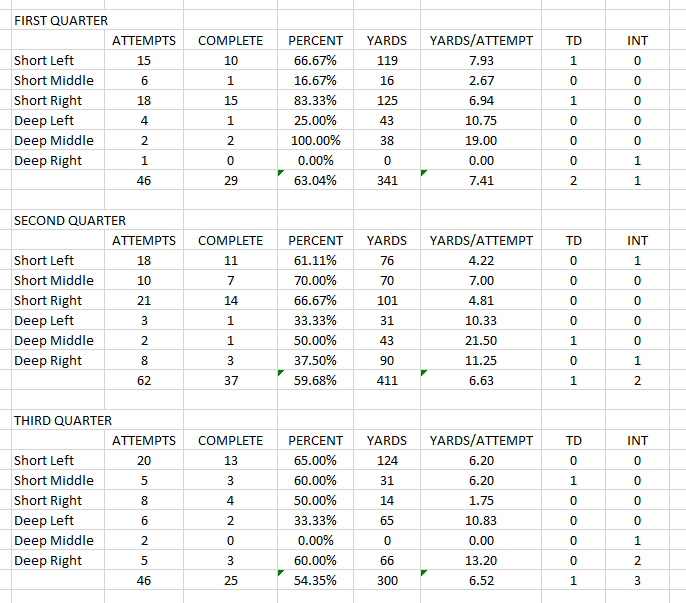
This is a detailed analysis review of Denver Broncos’ starting quarterback Case Keenum’s passing statistics through the first six games of the 2018 season. In short, Keenum is horrible through the first three quarters of the game and only getting Tim Tebow-like stats. But then, in the fourth quarter, he is padding his stats to make them look better with short passes up the middle of the field the opponent has no problem letting him have while the clock runs out on another Denver loss.

pro-football-reference.com is the original source for the data in this review. That site has the play by play of each game, the results of plays and whether passes were deep or short, and whether they were to the right, left or middle of the play. I then put every play, throw and result into a spreadsheet and began calculating the results.

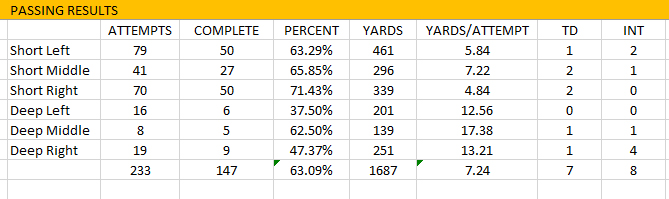
Here are Case Keenum’s overall quarterbacking statistics for a full game:

For this analysis we will now break these numbers down by quarter of play. For the first three quarters of games:

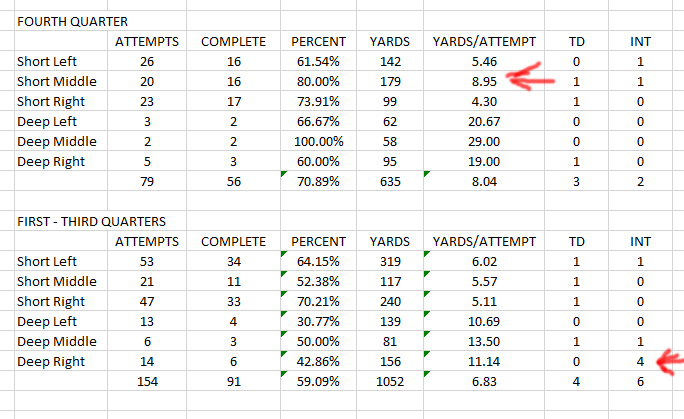
Now let us see what is happening in the all important 4th quarter, and comparing the numbers to what is happening in the first three quarters:

The contrast is stark and amazing.

For the first three quarters Case has but a 59 percent passing completion rate and is only averaging 6.8 yards per pass attempt. Compare that to the fourth quarter where his numbers dramatically increase to an over 70 percent passing completion rate and an average gain or more than 8 yards per pass attempt.

I wish this was due to impressive, crunch-time and captain-comeback quarterbacking bringing the team to wins, but with a 2 and 4 record that has obviously not happened.

In the first game of the year against the Seattle Seahawks Keenum did lead the Broncos to a game winning touchdown in the 4th quarter. However, at the time there was over 11 minutes left in the game. For the remainder of the game Keenum only passed for 11 yards on but 2 completed passes. It was the defense which held on for the win..

Against Oakland Keenum did bring the team back from a 19-7 deficit and certainly deserves credit for a job well done with long drives in the final quarter to win the game.

The four recent losses in a row have been bad. Those games were against the Ravens, Jets, Chiefs and Rams.

In the above graphs I noted in red a couple interesting statistics.

First, the 8.95 yards per pass down the middle of the field in the 4th quarter with an 80 percent completion rate. That is incredible. The problem is when you realize these numbers come from the end of game when the teams are in garbage time. These are easy passes the opponent is intentionally giving up in the middle of field to let the clock run out. Keenum is not targeting the sidelines to save time in hopes of a last minute win.

These garbage time easy passes are significantly running up Case Keenum’s overall pass completion rate and yards per attempt. However, the numbers should not really count due to the garbage time context.

Another interesting statistic are Keenum’s throws to the deep right of the field. He has four interceptions in this area and a very high interception rate.

Overall – not a good performance or results from a starting quarterback. Looking at Keenum’s overall passing numbers can be misleading since they are significantly padded from end of game, garbage time “gimme” passes.

How to be an Art Vendor for Sacramento Second Saturday

Second Saturday art events are popular in Sacramento. This is where art galleries are open extra hours and art lovers congregate to view what is new and for sale. There are also some tables outside art galleries where artists are showing their talents.

If you’re an artist … how the heck do you participate in Second Saturday?

The simplest method is to be invited into a gallery to participate.

It also turns out the City of Sacramento has a number of requirements. Typical of a government bureaucracy, Sacramento does not make it easy, inexpensive, or fun to try and participate. There are also no step-by-step instructions on how to be a Second Saturday artist. Welcome to this blog post!

Step 1: The Sacramento Business Operation Tax Account

The City of Sacramento imposes a tax on anyone doing business in the city. The city claims it is not a business license, but it is – just called a tax, or sometimes the city calls it a “fee” that must be paid up front.

The minimum annual tax/fee/license is $31.

Apply for the Business Operation Tax Account here: http://www.cityofsacramento.org/Finance/Revenue/Business-Operation-Tax/Apply-for-a-Business-Operation-Tax-Account

You can choose an online application or to download a paper application to send via mail.

As you can see, the $31 tax/fee/license amount is a minimum even if you don’t make that much:

bot1

You have to make more than $10,000 before a higher amount has to be paid:

bot2

You may ask, I’m an artist. Do I have to pay a business tax?

The answer is Yes. If you are selling you are in business. Even if you’re not making much as an artist, or even selling your artwork at a loss, you’re still subject to this tax.

When your application has been submitted and approved – and you have paid your fee, you will receive a “BOT” number.

[Sometimes] Step 2: The Art Vendor Permit

If you are selling INSIDE a gallery proceed to Step 3.

If you are selling OUTSIDE a building or gallery – such as near a sidewalk – there is another fee.

Paying the fee to obtain a BOT number does not allow you to be an outside art vendor on Second Saturday.

But the BOT fee allows you to pay another fee to obtain an Art Vendor Permit so you can sell on Second Saturday.

Sacramento has an information page about Second Saturday here.

Instead of simply telling you what to do on the web page, the city links to pdf files.

One file, called the “top sheet” when this is written, states:

“Participants wanting to display and/or sell art outside must obtain an Art Vendor permit.”

The word “outside” is what I am keying on.

There is then another form to fill out and another fee to be paid.

The requirements are of course bureaucratic:

– A copy of your driver’s license or state issued ID.

– Your BOT number.

– The BOT number must be obtained at least 14 days before the Second Saturday event.

– Two or more photos of your artwork.

– Signature of the property owner where your art will be displayed. There is an interesting twist here. If you are wanting to display on public property you need to get the signature of the nearest property owner for your application. Yes, you will probably have to pay them to get their signature. Good luck finding out who actually owns property and how to contact them.

– The Art Vendor application must be submitted to the Coloma Community Center Permit Office located at 4623 T Street, Monday thru Thursday between the hours of 10 am and 4 pm. Applications are due one week before each Second Saturday.

– The Art Vendor fee is $25 PER SECOND SATURDAY EVENT.

– No refunds for rain or bad weather.

Step 3: Gallery Fees

Expect to pay a fee and/or commission to a gallery you show at, or the property owner you are obtaining a signature from to set up an outside table.

How to Keep Your Highlander Looking Like New

My Toyota Highlander is no longer new – we’ve been through 9 years and 160,000 miles. That’s a long time and a lot of miles in one seat.

In some respects the “Truckster” as I call it is showing it’s age. Aren’t we all? But it’s also looking surprisingly good for all the wear and tear. Here are some ideas for keeping your ride happy.

– Keep it clean. Yes, this can be a challenge. Especially when hay and other horse supplies are being transported by those with muddy boots. Instead of letting the dirt build up take just a couple minutes with a vacuum and a cleaner. I’ve found windex works fine on the inside dash and not just for windows.

– Get some touch up paint. You never know when you’ll need it.

– Use the best vinyl cleaner possible on the seats. This is one area where I definitely should have used a higher quality product more often. When the seats get dirty they can be hard to get looking like new again.

– Get in the nooks and crannies. The Highlander is reasonably good at not having too many small places where dirt can accumulate that is difficult to reach. You may need to get into the backseat to reach some of the areas around the front seating area.

– A little squirt of ‘new car smell’ spray every once in a while can also help your senses feel like they are back in a brand new car.